
About €2,700 to €4,600 per person per month. Every month, for as long as the stay lasts.
This article is not against care homes. For many people they are the right choice: when care needs become too heavy, when loneliness weighs, or when home is no longer safe. But the decision is often made in a hurry, after a fall or a hospital stay, without the figures in front of you. Here they are.
How much does a care home cost in Luxembourg in 2026?
In Luxembourg the monthly charge is called the "prix d'hébergement" (accommodation price). Each home (CIPA, nursing home, seniorie) sets its own, and the resident pays it every month. It covers the room, meals, cleaning, help with daily activities and social activities.
Some published prices, per person per month:
| Home | Monthly price | Rate valid from |
|---|---|---|
| SERVIOR Am Park, Bofferdange | €2,856 to €3,828 | 01/01/2026 |
| SERVIOR Woiwer, Differdange | €3,577 | 01/01/2026 |
| SERVIOR Op der Rhum, Luxembourg City | €3,198 to €4,629 | 01/01/2026 |
| ZithaSenior, Seniorie St Joseph, Pétange | €2,672 to €3,497 | 01/05/2025 |
| ZithaSenior, Seniorie St Jean de la Croix, Luxembourg City | €3,139 to €4,405 | 01/05/2025 |
Prices depend on the size and fittings of the room (washbasin only, toilet, private shower). Some rooms or apartments cost more.
What dependency insurance pays, and what it does not
This is the point many families discover late. In a care home, dependency insurance (assurance dépendance) covers care and some technical aids. It does not pay for accommodation. Guichet.lu states that hotel costs, such as room rent and meals, remain payable by the dependent person.
Would you like to know the price for your staircase?
There are often extra charges too. One example from the published price list of CIPA Gréngewald in Niederanven: personal laundry €89 a month, telephone €20 a month, parking €30 a month, Wi-Fi about €35 a month. Nothing unusual, but it adds up.
Over one year, over three years
| Duration | Room at about €2,700 / month | Room at about €4,600 / month |
|---|---|---|
| 1 year | €32,400 | €55,200 |
| 3 years | €97,200 | €165,600 |
These amounts exclude extra charges and price increases from indexation.
Worked example (illustrative): a room at €3,200 a month and a pension of €2,000 a month. That leaves €1,200 missing every month: €14,400 a year and €43,200 over three years, before extra charges. The gap is usually covered by savings, selling a property or help from the children.
This is not an unusual case. A study by the Chamber of Employees (CSL) found that in 2018, about 76% of women received an old-age pension below the average price of a single room in a CIPA (€2,452 at the time). Prices have risen since.
If income is not enough
The National Solidarity Fund (FNS) can pay a supplement towards care-home accommodation ("complément accueil gérontologique") when personal resources do not cover the accommodation price. It is paid directly to the home, which must be approved and located in Luxembourg. The conditions are strict, so check with the FNS before committing.
Staying at home: what changes in the sums
Often it is not the whole house that is the problem, but a single obstacle: the stairs, the bathroom or the steps at the entrance. This is where the comparison gets interesting.
Would you like to know the price for your staircase?
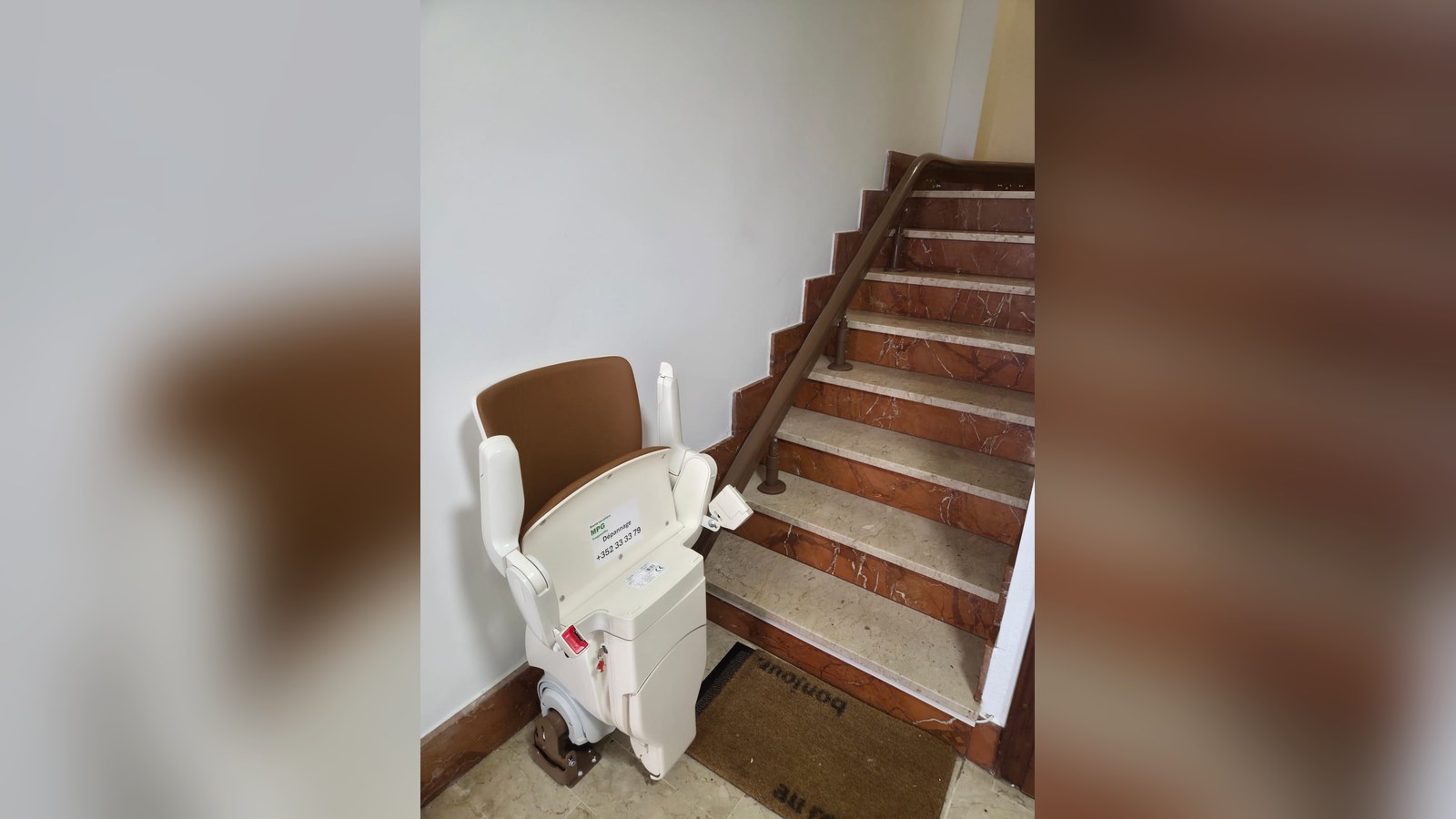
A stairlift is not paid for every month. It is a one-off investment: depending on the staircase, the equivalent of a few months in a care home, then an annual service. The exact price depends on your stairs (straight, curved, one or more floors), which is why we give it in writing after a free home visit. Live in an apartment? It is often possible too, even on a shared staircase: see our article on a stairlift in an apartment.
Dependency insurance can also cover a stairlift as a technical aid, after assessment by the AEC. The level of cover depends on each case. Our R20 form guide explains the steps.
To be honest: staying at home has a cost too. You may need home care, help with housework or shopping, or other adaptations. Dependency insurance can cover part of home care, depending on the assessment. And for some people, home is simply no longer the right answer, even adapted. To make the rest of the house safer, read our guide to preventing falls at home.
How to decide calmly
Before choosing, ask these questions as a family, ideally with the family doctor:
What exactly prevents staying at home? A specific obstacle (stairs, shower) can often be solved. A need for supervision day and night, much less so.
What do both options really cost over 2 or 3 years? Accommodation and extra charges on one side; adaptations, servicing and home help on the other.
What does the person concerned want? Often the most important criterion, and the first one forgotten.
Has the dependency insurance application been made? The sooner it is made, the sooner the assessment takes place.
Frequently asked questions
How much does a care home in Luxembourg cost per month?
According to published price lists, expect about €2,700 to €4,600 per person per month, depending on the home and the room. Extra charges (laundry, telephone, parking) come on top.
Does dependency insurance pay for a care home?
Not the accommodation. It covers care and some technical aids. The room and meals are paid by the resident.
Would you like to know the price for your staircase?
Is there help if the pension is not enough?
Yes. The National Solidarity Fund (FNS) can pay a supplement towards care-home accommodation, subject to means.
Can a stairlift be covered?
Yes, dependency insurance can cover it as a technical aid, after assessment by the AEC. The level of cover depends on each case.
Let's talk about your situation
Weighing up adapting the house against moving into a care home? We come to you free of charge and with no obligation, look at the stairs or bathroom, and give you a written price. You can then compare with real figures.
Free home visit and quote: +352 33 33 73 or request a quote online.
Prices collected on 19 October 2026 from the price lists published by the homes (infosenior.public.lu). They may change, in particular with indexation. Sources: SERVIOR, ZithaSenior, CIPA Gréngewald, guichet.lu, FNS, Chamber of Employees.